
Thursday, October 4
Agenda
| 7:30am | Community Breakfast | ||
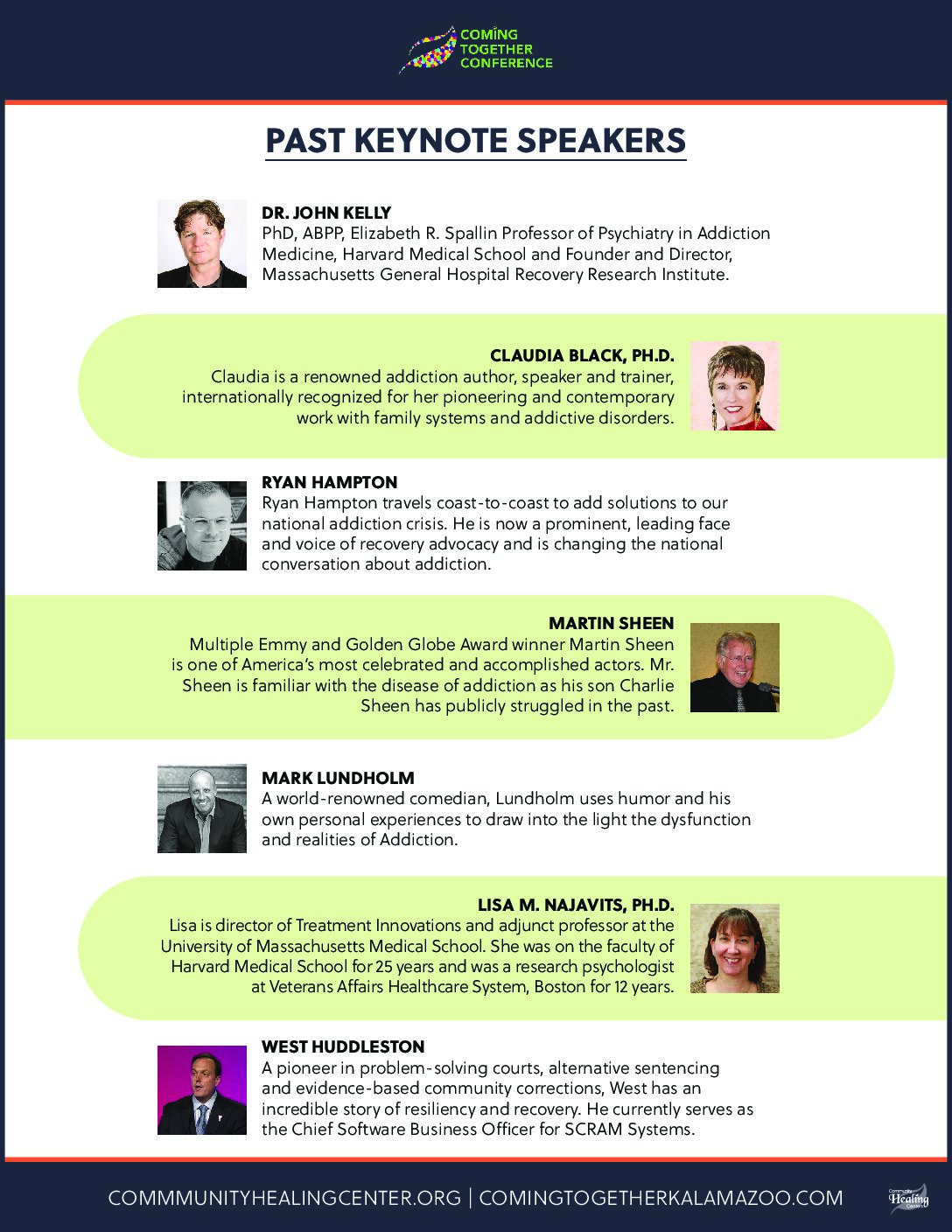
| Martin Sheen and Earl Hightower | |||
| 8:30 | Community Breakfast Adjourns | ||
| 8:45 | Conference Welcome | ||
| Sally Reames, Executive Director Community Healing Centers, and Hon. William G. Schma, President, Drug Treatment Court Foundation of Kalamazoo County. | |||
| 9:00 | Opening Keynote | ||
| Martin Sheen, Golden Globe and Emmy-Award Winning Actor, Drug/Alcohol Treatment Advocate, and NADCP's First All Rise Amassador. | ![]() |
||
| 9:30 | Keynote | ||
| Earl Hightower, Certified Chemical Dependency Counselor, Board Registered Interventionist-Level II, and Stanley Goldstein Drug Court Hall of Fame Inductee. | ![]() |
||
| 10:15 | Break | ||
| 10:30 | Breakout Sessions I | ||
| A. | Addiction Essentials for Clinicians and Patients | ||
| Carlton Erickson, Pfizer Centennial Professor of Pharmacology/Toxicology; Associate Dean for Research and Graduate Studies; Graduate Advisor; and Director, Addiction Science Research and Education Center, College of Pharmacy, The University of Texas. | |||
| This presentation will cover the latest neurobiology findings (simplified) related to the causes of addiction, as well as some controversial issues related to research and treatment of addictions. | |||
| B. | 12 Steps: How AA Works in Recovery | ||
| Tori L, Ken K, and Mel L | |||
| This panel of presenters, having been given the gift of sobriety, will use their personal experience in recovery to explain the importance and benefit of participation in the AA program. From an "insiders" view, they will explore the myths, mysteries, and realities of what AA is... and what it is not. Resource material will be available as well as ample time for Q&A. | |||
| C. | Women's Issues in Addiction and Recovery | ||
| Marian Thornton, Coordinator of Women's Specialty Program/Bethany House, Community Healing Centers, and Tiffany Lee, Assistant Professor, Special Program in Alcohol and Drug Abuse, Western Michigan University. | |||
| Women with addictions have several issues that don’t apply to their male counterparts. This presentation will talk about women needing resources to be able to maintain a drug and alcohol free life. It will also encompass how the children of these women are affected and can be helped. | |||
| D. | PTSD and Addiction | ||
| Carman Stark, Clinical Psychologist, Veterans Affairs Medical Center. | |||
| This presentation will cover the diagnostic criteria for PTSD (Post Traumatic Stress Disorder), issues involving combat-related and noncombat-related PTSD; PTSD and co-morbid SUD (Substance Use Disorders); gender differences regarding PTSD and SUD; treatment options including evidenced based psychotherapies and medications. | |||
| 11:30 | Breakout Sessions II (repeat of Breakout Sessions I) | ||
| 12:30 | Lunch | ||
| 1:15 | Updated Diagnoses and Evidence-Based Treatments for Addiction | ||
| Carlton Erickson, Pfizer Centennial Professor of Pharmacology/Toxicology; Associate Dean for Research and Graduate Studies; Graduate Adviser; and Director, Addiction Science Research and Education Center, College of Pharmacy, The University of Texas. | ![]() |
||
| This presentation will discuss the anticipated DSM-V changes in the diagnoses of addictions and co-morbid conditions, and the latest evidence-based treatments for substance use disorders. | |||
| 2:45 | Break | ||
| 3:00 | Breakout Sessions III | ||
| A. | Advanced Treatment for Substance Abuse | ||
| Gregory Blevins, Professor and Department Chair, Addiction Studies/Behavioral Health, Governors State University, and Tiffany Lee, Assistant Professor, Special Program in Alcohol and Drug Abuse, Western Michigan University. | |||
| This session will address the future of addiction treatment. Discussions will focus on recovery oriented systems of care (ROSC), the DSM-V, recovery coaching/peer support, and evidence-based practices. The ideology of acute vs. chronic care will be explored in order for helpers to screen, assess, refer, and/or treat persons with addictions. | |||
| B. | The Drug Treatment Courts | ||
| Kurt P. McCamman, Attorney and Counselor at Law, Miller Canfield Paddock and Stone; Jeff Hadley, Chief, Kalamazoo Department of Public Safety; and Hon. Robert C. Kropf, Kalamazoo County 8th District Court. | |||
| This session will explain the workings of a drug treatment court and how it differs from a traditional criminal court. The session will also explain the role the judge, prosecutor, and defense attorney perform in court and in developing a plan for each participant. The law enforcement officers will explain how the drug treatment court affects public safety. | |||
| C. | Neuropsychology Case Studies | ||
| Alan Lewandowski, Board Certified Neuropsychologist and Clinical Director, Neuropsychology Associates. | |||
| This workshop will use a case study format to familiarize participants with the effects of long-term alcohol use on cognitive performance. The components of a neuropsychological examination will be discussed as well as the utility of this diagnostic procedure as a part of a comprehensive evaluation in the medial assessment of chronic alcohol use. | |||
| D. | A Picture of Adolescent Substance Use Trends in Kalamazoo County | ||
| Tonya Collins, Coordinator, Kalamazoo County Substance Abuse Task Force, and Charlene Taylor, Prevention Specialist, Community Healing Centers. | |||
| This session will highlight current substance use trends in Kalamazoo County based on data collected by the Kalamazoo County Substance Abuse Task Force over the past four years. The focus will be on the issues with prescription drug abuse and underage drinking, with updates on emerging trends in our community, especially those that impact our young people. | |||
| 4:00 | Breakout Sessions IV (Repeat of Breakout Sessions III) | ||
| 5:00pm | Adjourn |


recovery, while facilitating conversation and partnerships with a variety of community organizations. We will raise awareness of the programs and outreach services available in the community for those children, families, and individuals struggling in the shadows of addiction.